
AlphaZero Checkers
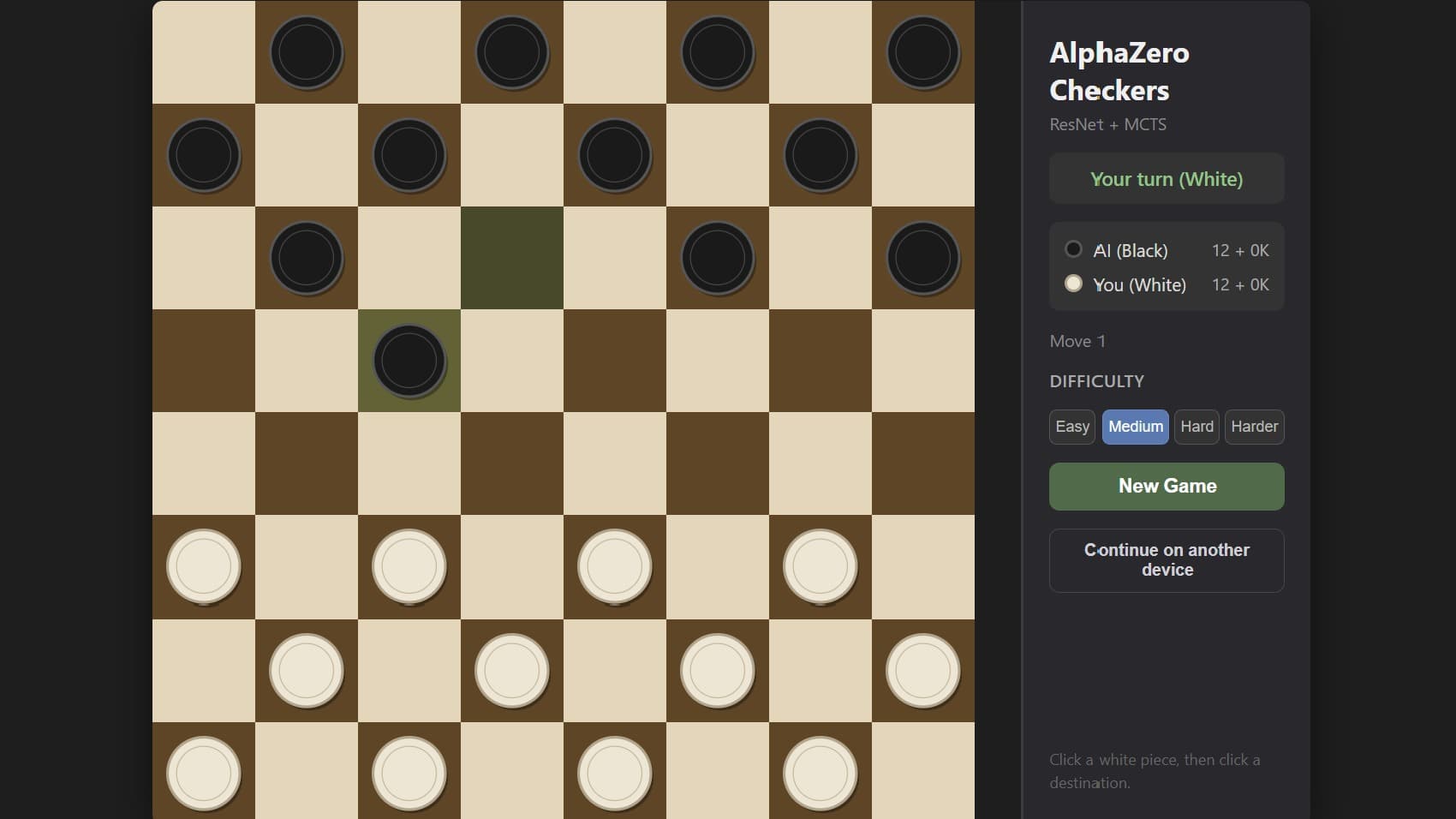
A checkers AI trained through reinforcement learning and self-play, combining a residual neural network with Monte Carlo Tree Search to choose its moves.
Project Details
About the Project
Could a computer teach itself to play checkers?
That is what we set out to explore with AlphaZero Checkers, a checkers-playing AI inspired by AlphaZero. The model was trained through reinforcement learning, learning strategies by repeatedly playing against itself rather than relying on recorded human matches or hand-crafted strategies.
The deployed web application uses a fixed, pretrained version of the resulting model. Games played by users do not retrain or modify it.
Rationale
We created the project to understand how self-play can be used to train game-playing artificial intelligence. We began by experimenting with simpler games such as tic-tac-toe before progressing to the larger state space and more complex decisions involved in checkers.
Reinforcement Learning
During training, Monte Carlo Tree Search (MCTS) explored possible moves with guidance from a neural network. Each self-play game generated training examples using the board positions encountered, the moves explored by MCTS, and the final result.
A dual-head residual neural network was trained to predict:
- which moves were most promising from a given position; and
- the expected outcome of the game.
Newly trained versions were evaluated against the previous best model. A candidate was retained only when it demonstrated stronger performance, allowing the agent to improve over successive training iterations.
From Model to Web App
After training, we integrated the selected model checkpoint into an interactive web application. Players can challenge the AI at different difficulty levels, which adjust how extensively it searches for its next move.
In an evaluation against a random-move opponent, the selected model won 97 out of 100 games, indicating that it had learnt consistent checkers strategies during training.
Project Satisfaction
5/5. We progressed from being unable to train a successful tic-tac-toe agent to developing a model that consistently learns checkers strategies. Successfully completing the full self-play, training, and evaluation pipeline made the project especially rewarding!
Key Takeaway
Looking back, we would have explored a more sophisticated neural network architecture from the beginning instead of spending as long trying to make a basic neural network work. The experience showed us how much reinforcement learning involves experimentation, iteration, and learning through trial and error.