
EquityLens AI
An investment research workspace that combines Python-calculated financials and valuations with AI research agents, keeping assumptions and evidence visible.


Project Details
About the Project
As a business student interested in finance and AI, I wanted to make investment research more accessible and easier to verify. Analysing a company means switching between financial reports, spreadsheets, valuation models and research notes. AI can help organise all of that, but a convincing answer is not necessarily an accurate one.
EquityLens AI guides you through the research process, from setting up a company workspace and adding financial documents to analysing performance, building valuations and developing an investment thesis. A built-in synthetic company lets you explore without uploading anything confidential.
What It Does
The main features are:
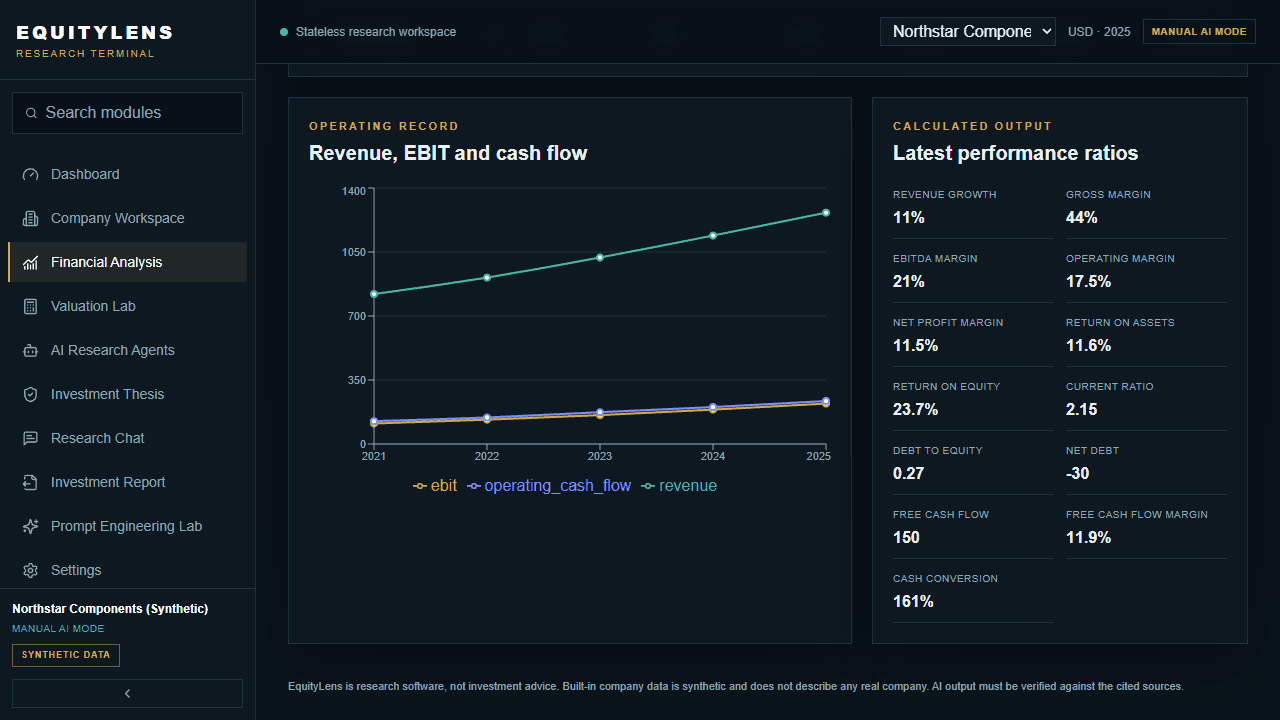
- financial analysis — editable historical figures, source information and Python-calculated ratios;
- Valuation Lab — a five-year discounted cash flow model, bear/base/bull scenarios, sensitivity analysis and comparable-company multiples;
- research agents — financial, valuation and risk analysts, an investment committee critic and an evidence verification agent;
- Research Chat — document retrieval and source-referenced questions; and
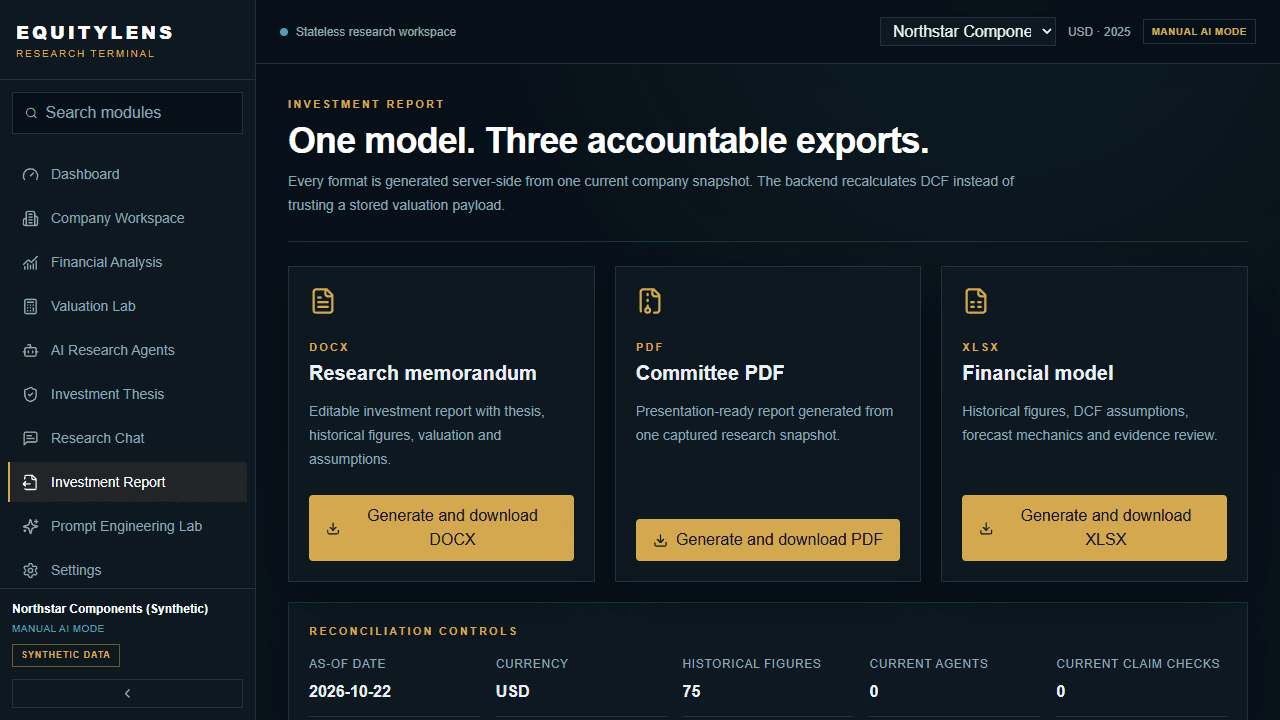
- investment reports — PDF, DOCX and Excel exports.
Numbers in Code, Interpretation by AI
A key design decision was to separate numerical calculations from AI interpretation. Python calculates the ratios, discounted cash flows and valuation scenarios, and the AI prompts use those results as context. Every AI response is checked against a schema and a citation allowlist before it is saved.
There is also a Manual AI Mode: you generate a specialised prompt, run it in your preferred AI tool and paste the JSON response back for validation. Projects are stored in your browser, with JSON import and export.
Challenges
Moving from a Streamlit app to a Next.js frontend and a stateless Python backend meant rethinking routing, backend communication and storage. Financial document extraction was hard too: during testing, a simple synthetic PDF exposed an error that assigned a capital expenditure figure to operating cash flow, which is why extracted suggestions stay separate from the financial ledger until an analyst reviews them.
Project Satisfaction
I'm proud of bringing financial calculations, valuation and evidence-focused research into one working application, where users can explore scenarios, inspect assumptions and challenge conclusions in the same workspace.
Key Takeaway
A figure needs a reporting period, currency, scale and source, not just a value. Most importantly, I learnt to treat AI output as something to examine: structured responses and citations make review easier, but they don't replace financial reasoning or evidence checks.
Areas for Improvement
Next, I'd improve extraction accuracy, make currency and unit scales consistent, produce more complete reports, and add more reliable real-time financial data and portfolio analysis.