
MemeMe
An AI sticker maker that turns a photo of you, a friend or your pet into a captioned die-cut meme sticker, with safety checks built in from the start.

Project Details
About the Project
Sticker packs are generic, and a proper meme of your own dog or friend takes design skill and time most people don't have. My group chats run on stickers, and I wanted ones made from our actual photos. I also wanted to find out whether a fun consumer app could ship with safety built in from day one.
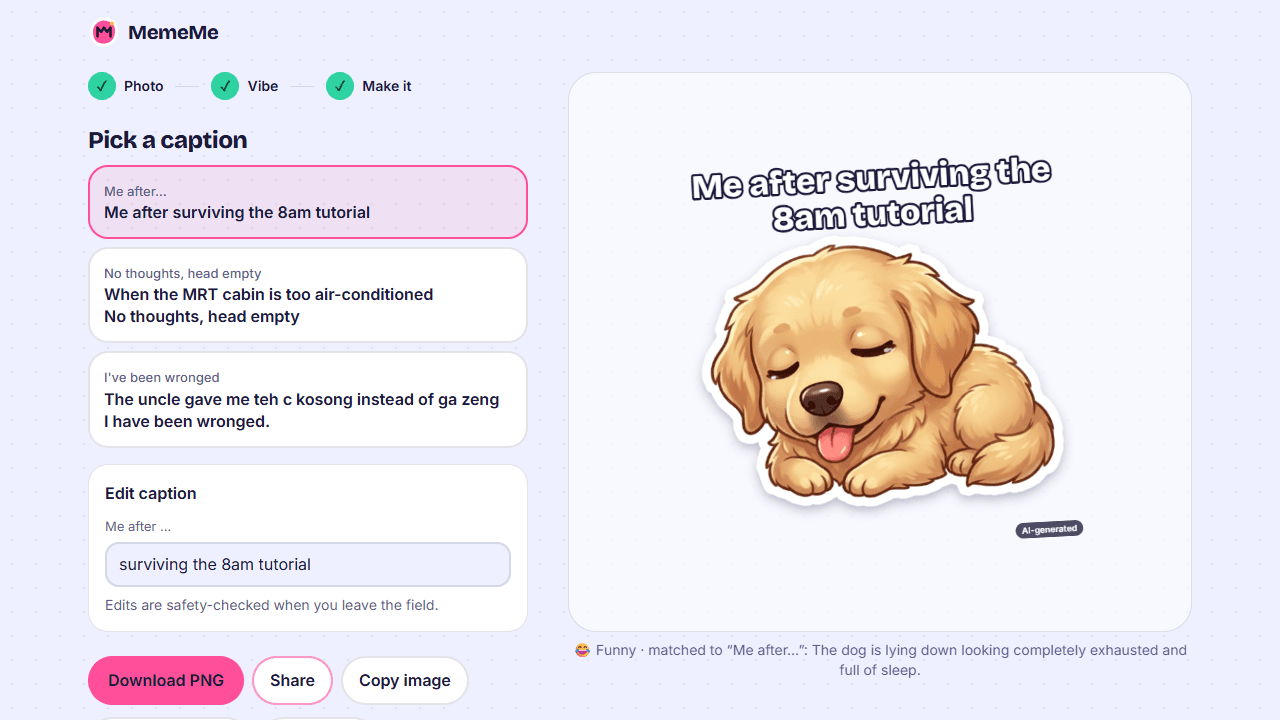
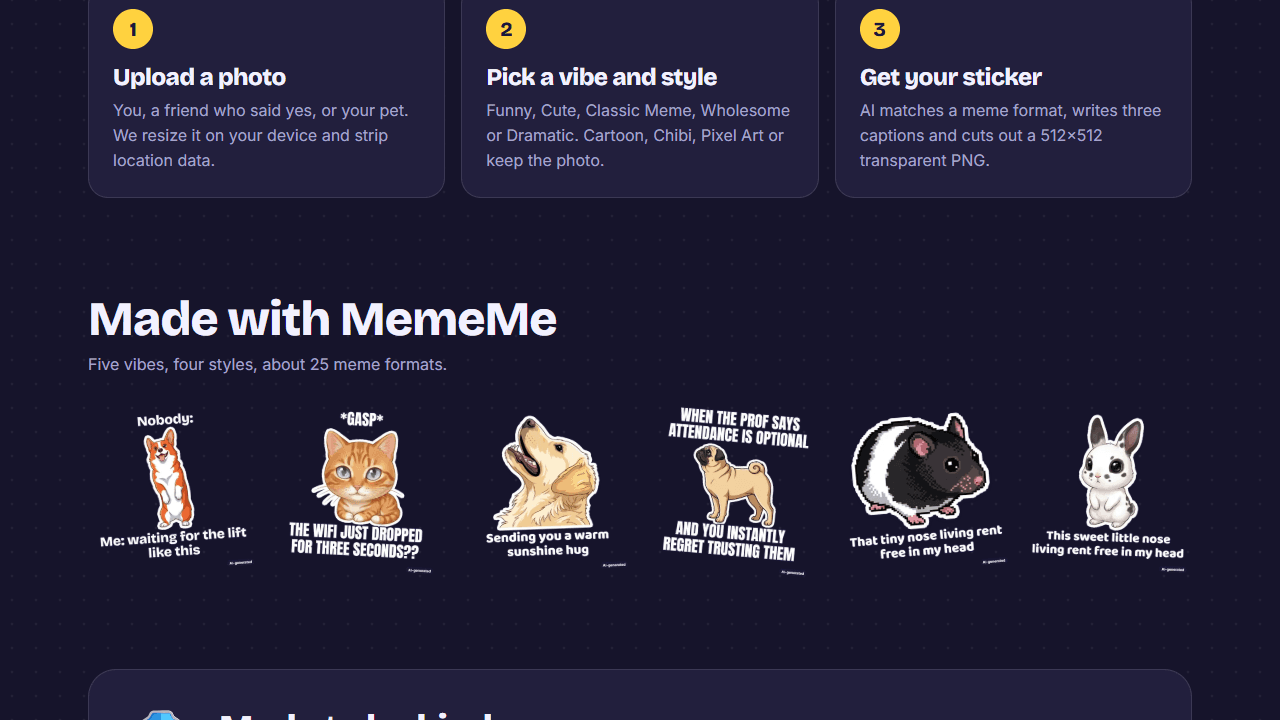
MemeMe turns a photo into a die-cut meme sticker in about 20 seconds. You pick one of 5 vibes (Funny, Cute, Classic Meme, Wholesome, Dramatic) and one of 4 styles (Cartoon, Chibi, Pixel Art or Keep Photo). MemeMe matches the photo to a meme format, writes three caption options and exports a 512×512 transparent PNG ready for Telegram or WhatsApp.
How It Works
Each photo goes through a chain of steps, each with its own job:
- safety gate and analysis — one vision call returns a structured safety report and a neutral description of the subject;
- template matcher — code filters my own dataset of 28 hand-written meme formats, then the model ranks the top three;
- caption writer and moderator — the model fills only the template's slots, and a blocklist plus a separate classifier check every caption; and
- stylizer and compositor — an image model redraws the subject in the chosen style, and the browser cuts it out, adds a white outline and draws the text.
Safety First
Anyone can upload any photo, so the safety gate runs before anything else and blocks likely minors, public figures, explicit content and photos with no clear subject. The allow-or-block decision is made in code, never by trusting a model's yes or no. Photos are resized and re-encoded on the device, which strips EXIF and GPS data, and they're never stored. My 12-case safety eval covering minors, celebrities, prompt injection, slurs and malformed model output passes all 12.
Project Satisfaction
The first time the whole pipeline ran end to end, the progress ticks resolved one by one and the sticker slapped onto the screen with a shine sweep. It finally felt like a real product. Seeing the safety eval pass 12 out of 12 was a close second.
Key Takeaway
The app improved whenever I leaned on my own dataset and plain code instead of asking a model to do everything. Image models render text badly, for example, so every caption is drawn in code with real fonts. Safety works better as a design decision at the start than as a patch at the end.