
TrustKaki
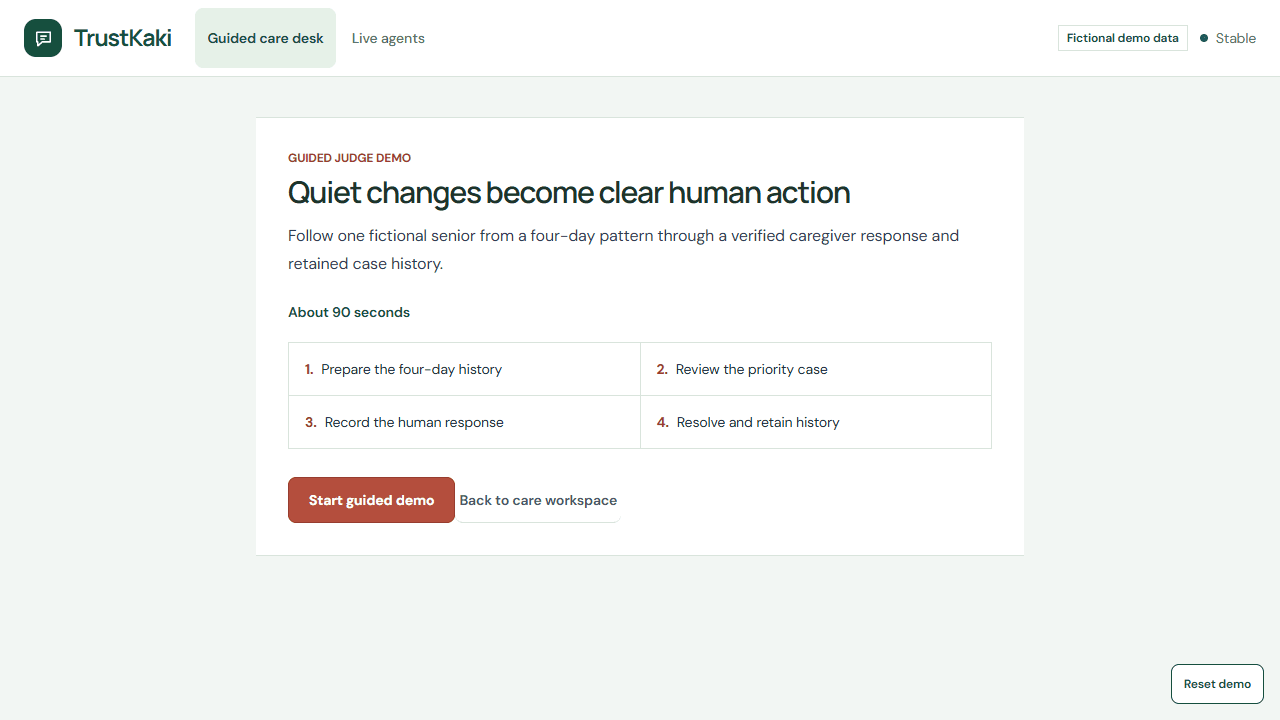
An AI care-coordination system for Singapore’s Active Ageing Centres that turns everyday senior conversations into evidence-backed cases for human follow-up by care staff.
Project Details
About the Project
“My knee hurts.” “Not hungry today.” “Don’t feel like going downstairs.”
Individually, these messages may seem ordinary. Across several days, they may suggest that someone needs a check-in.
I built TrustKaki for Active Ageing Centres (AACs): a system that turns everyday senior conversations into clearer, evidence-backed human follow-up. Seniors chat through familiar messaging channels, while staff use a care workspace that answers three questions: who needs attention, what changed and what evidence supports it, and what a human should do next.
Rationale
As Singapore’s population ages, care organisations face a growing challenge: keeping personal, consistent contact with seniors while managing limited staff time. Important context can become scattered across conversations and staff handovers.
The environmental feature had a personal inspiration. Haze made me think that before encouraging a senior to head outside, we should check the air first.
Following One Senior’s Journey
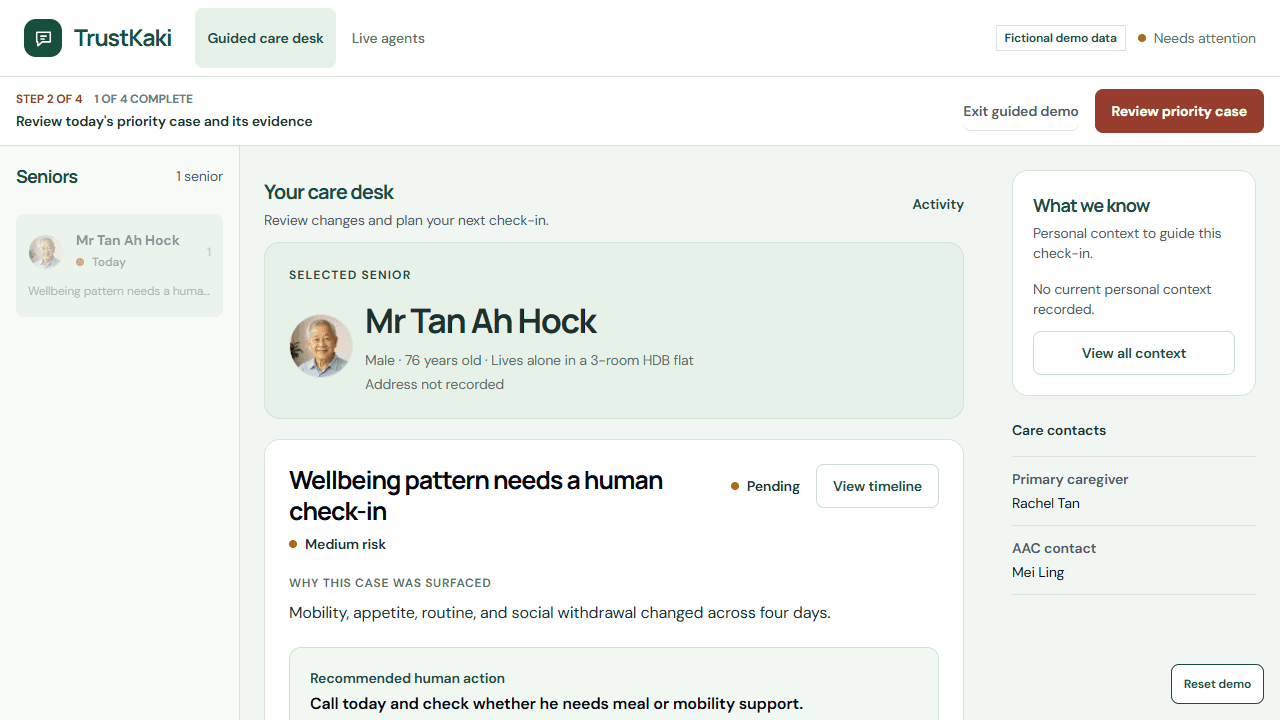
Mr Tan mentions knee discomfort and skipping breakfast. TrustKaki interprets the message as care-related observations and replies using relevant personal context. If he prefers quiet, one-to-one conversations, retrieved memory can help the reply suggest a suitable form of support instead of a generic group activity.
Later observations, such as avoiding trips downstairs, missing meals or withdrawing from usual activities, can add up to a pattern across days. Staff then receive a surfaced case with the supporting timeline and a suggested follow-up, such as calling to ask whether the discomfort is affecting his meals and movement.
The staff member decides what to do and records the outcome. TrustKaki supports that decision; it does not diagnose the senior.
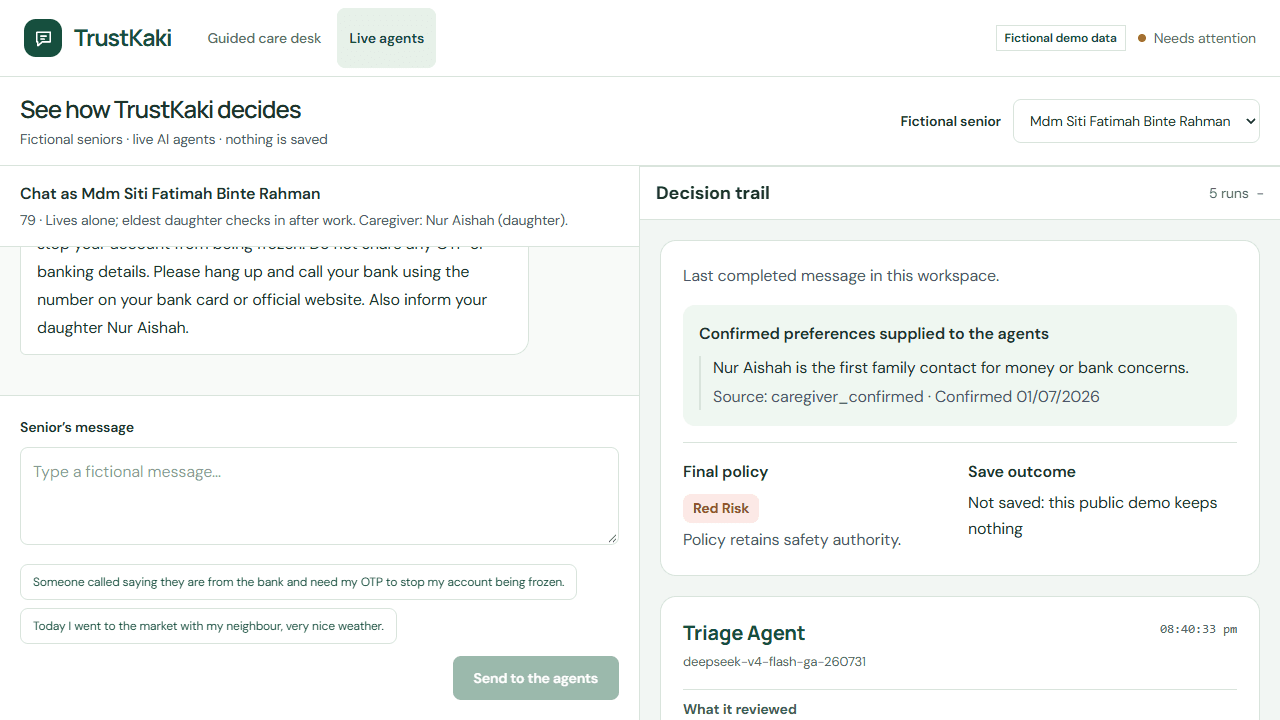
It helps with everyday risks too. An outdoor plan can trigger a weather and air-quality check using data.gov.sg/NEA readings, without the senior asking about the weather, and a suspicious payment request brings in a Digital Safety specialist that encourages verification before transferring money or sharing information.
How It Works
I gave each component a distinct responsibility:
- triage — interprets the current message and proposes care or safety signals;
- personal-memory retrieval — supplies relevant saved facts and preferences for the selected senior;
- specialist routing — Jev selects the relevant specialist, such as digital safety or outdoor context, instead of invoking every specialist for every message;
- application policy — validates outputs and controls safety decisions and permitted actions;
- pattern detection — checks saved observations across days for supported combinations; and
- care briefing — summarises the evidence and suggests a practical human follow-up.
OpenAI models interpret informal language, so seniors don’t need to phrase messages as forms or commands, but their outputs are validated before they influence any action. Supabase handles staff authentication and operational care records, while Neon with pgvector powers personal-memory retrieval. Keeping the two separate makes their roles explicit: a conversational preference is not the same thing as an authoritative care observation.
In the judge workspace, reviewers can send fictional messages and inspect the retrieved memory, specialist execution, policy result and save outcome, so the system’s behaviour is visible beyond the final reply. The demo uses fictional senior profiles and care records.
Safety Is Part of the Workflow
A care system needs more than a reassuring tone, so safety is built into each step:
- human oversight — surfaced cases support staff review, not automated diagnosis;
- validated memory — candidate memories pass checks before storage, because saying “I’ll remember” is not proof of a successful save;
- prompt boundaries — messages and retrieved text are treated as context, not as authority to override system instructions;
- grounded advice — weather and air-quality replies respect the location, freshness and forecast coverage of the available data; and
- access control — live AI testing requires authentication, while the public walkthrough uses fictional, browser-only data.
My Project Journey
The hardest part was making a multi-component system behave like one coherent conversation. Early tests exposed lost messaging history, repeated environmental advice and replies that sounded like system notices, so I revised history handling, current-message routing and response safeguards, then rechecked each failure scenario.
Building the secure application around the AI was another major challenge. TrustKaki has to tell seniors, caregivers and AAC staff apart, connect each message to the right senior and restrict access to personal information. I built role-based access on Supabase with user profiles, authorised messaging identities and row-level security policies, and left password handling to Supabase Auth rather than storing passwords in application tables.
Telegram is the channel shown in the demo. I also successfully tested the WhatsApp integration, but the test account was later restricted by the platform, so live WhatsApp delivery is on hold for now.
Project Satisfaction
I’m most proud of applying what I learnt at AI Lodge — AI agents, system prompt design and RAG — in a working senior-care workflow. I also independently explored Neon, a PostgreSQL platform I hadn’t used before, and learnt to use it with pgvector for personal-memory retrieval. Seeing all the pieces work together was the most rewarding part.
Key Takeaway
Testing individual prompts isn’t enough: a system also has to handle acknowledgements, corrections and changing plans without losing context. I learnt to tell a convincing reply apart from a correct system outcome, and that responsible AI needs database permissions, identity checks, validated outputs and inspectable actions, not just careful prompts.
Areas for Improvement
With more time, I would run a supervised pilot with an Active Ageing Centre, measuring factual accuracy, unnecessary alerts, missed concerns and time to human response. I would also improve multilingual and voice-message support, refine memory retrieval, and validate reliable messaging delivery and scheduled outreach before wider deployment.
Build a project with us
Join AI Lodge, build with your track through the semester, and show your project at Hack Day. We will feature it here.