
Hunch
A multiplayer price-guessing party game that doubles as a consumer pricing research tool, turning opt-in guesses into anonymous insights for brands with an AI analyst.
Project Details
About the Project
What if a party game could tell brands what shoppers really think their products are worth?
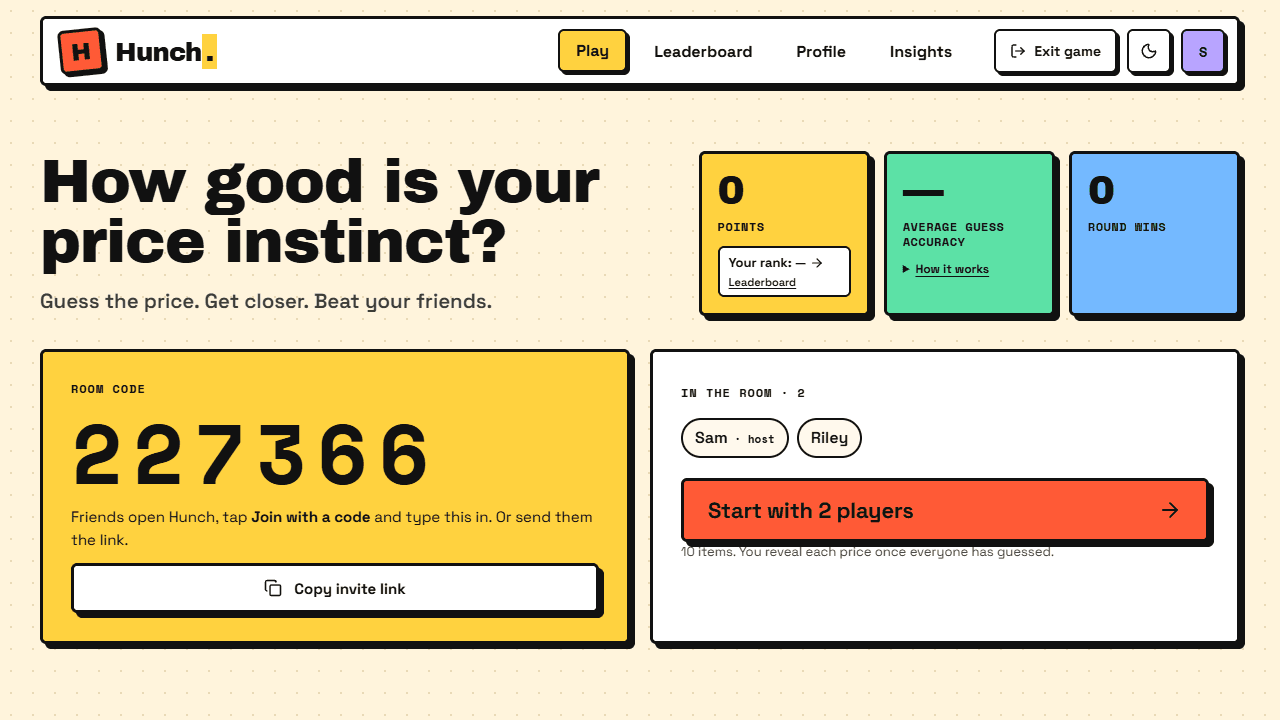
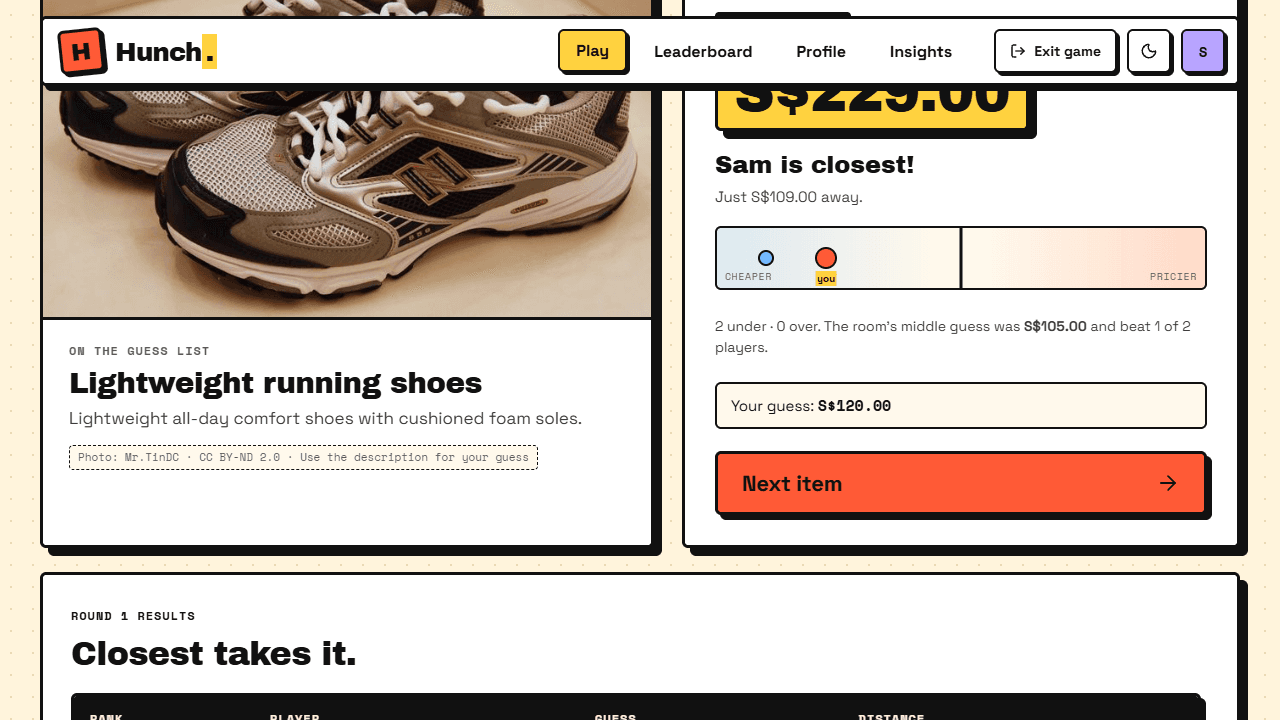
On the surface, Hunch is a multiplayer Price Is Right-style game. A host creates a room, friends join on their phones with a 6-character code, and everyone guesses the price of 10 products drawn from 8 categories, from Tech to Food and Drink. Guesses stay hidden until the host reveals the price, and points go to whoever is closest.
Underneath, it’s a consumer pricing research tool.
Rationale
I play GeoGuessr with my friends in class when lessons get slow, and I wanted to build something just as easy to pick up. Then I realised a price-guessing game collects something valuable by accident: what people think products are worth. Companies pay a lot for consumer pricing research, and surveys are boring. A game isn’t.
The Research Side
Every opted-in guess becomes anonymous data:
- opt-in research — players choose whether to share their guesses, and can answer “what’s the most you’d pay?” before the reveal;
- company portal — each company gets its own access key and a pooled report showing median perceived price, the spread of guesses, over- or under-estimation by category and stated willingness to pay, exportable to CSV;
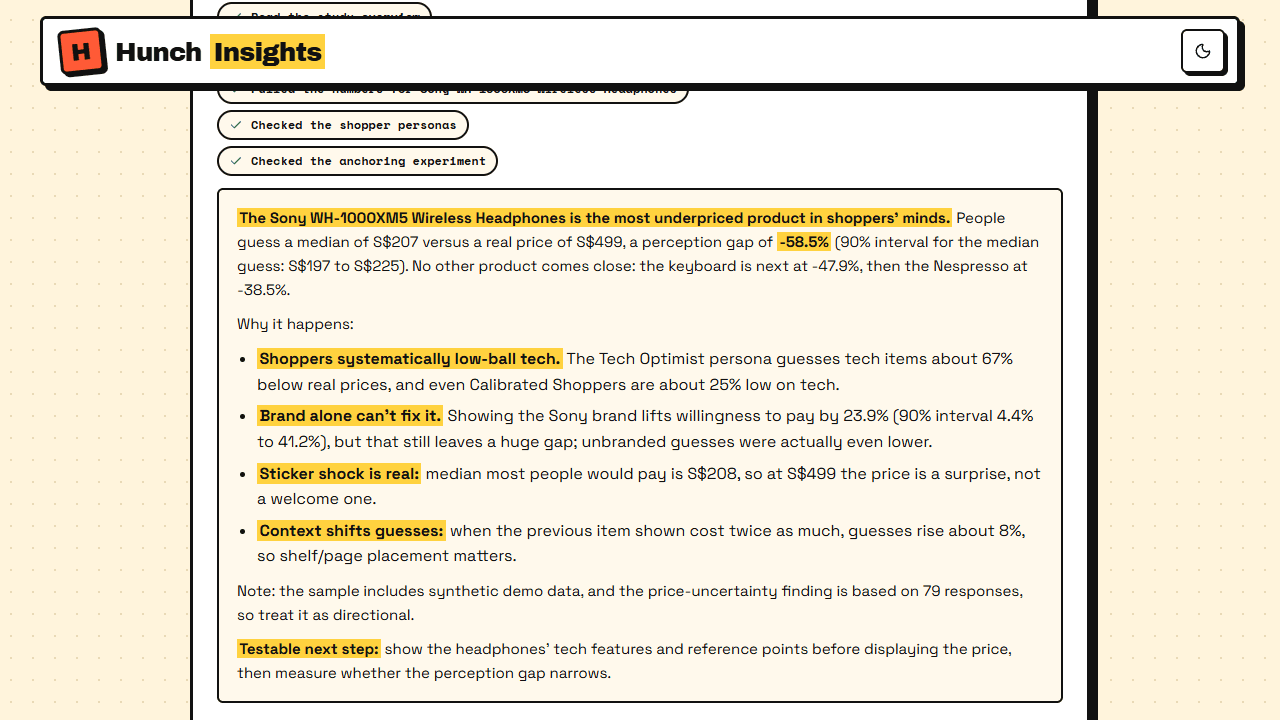
- AI analyst — companies ask plain-English questions like “Do people think our snacks are overpriced?” and get answers backed by the study data; and
- privacy by design — nothing is published until a product has at least 5 responses, companies only see aggregates, and every data pull is logged.
How It Works
The game runs on React and Vite with Recharts dashboards, a Node.js API, and Postgres on Supabase, deployed on Vercel. Hunch started as a local Wi-Fi game, so I had to migrate it to Postgres and serverless hosting without breaking multiplayer.
The analyst is a tool-using Gemini agent. LLMs love confident statistics, so the model only decides which analyses to run; the server calculates every figure in code, and the agent is forbidden from stating any number it hasn’t looked up. Actual prices and other players’ guesses also never leave the server until the reveal, so nobody can peek in their browser.
Project Satisfaction
I’m very proud that something so fun could be monetised, and that I could see it. I built and deployed the whole product solo — game, research pipeline, company portal and AI agent — and wrote a pilot offer for cafés, beauty brands and retailers.
Key Takeaway
Good research design matters as much as good code. A guess measures what people think something costs, not what they would buy, so I kept perception and willingness to pay as separate measures. I also learnt that privacy and consent are far easier to build in from day one than to bolt on later.
Areas for Improvement
With more time, I would polish the UI and work on engagement — enticing more people to actually play the game.
Build a project with us
Join AI Lodge, build with your track through the semester, and show your project at Hack Day. We will feature it here.